Genetics · Comparison
Genetic Testing vs. Blood Testing: What's the Difference and Do You Need Both?
Quick answer
What's the difference between genetic testing and blood testing?
Genetic testing reads your DNA to reveal lifelong tendencies — such as how efficiently you may activate folate or clear caffeine. Blood testing measures your current status — like homocysteine, vitamin D or cholesterol — which changes with diet and lifestyle. Genetics explains “why you might be prone”; blood work shows “where you are now.” They're most useful together.
Definition
What are genetic testing and blood testing?
Genetic testing analyzes DNA from saliva, a cheek swab or blood to identify variants you were born with. Wellness panels focus on genes tied to methylation, nutrients, caffeine and fitness. Your results never change.
Blood testing measures biomarkers circulating in your blood right now — nutrients, lipids, glucose, hormones, inflammatory markers and organ function. Results change as your habits, health and age change.
Why it matters
Why the difference matters
Using genetics alone can lead to over- or under-reacting: an MTHFR variant doesn't tell you whether your homocysteine is actually elevated. Using blood work alone can miss why a marker keeps drifting despite your efforts. Combining them creates a personalized, measurable plan — which is the logic behind multi-step approaches like the 10X Health System (gene test, blood test, expert analysis, customized recommendations).
At a glance
Key takeaways
- Genetic tests show fixed tendencies; blood tests show changeable current status.
- You typically need a genetic test once; blood tests are repeated over time.
- Blood markers confirm whether a genetic tendency is actually affecting you.
- Together they support a test → act → retest loop.
Side by side
Genetic testing vs. Blood testing at a glance
| Feature | Genetic testing | Blood testing |
|---|---|---|
| What it measures | DNA variants you were born with | Current levels of biomarkers |
| Changes over time? | No | Yes |
| How often | Once | Periodically (e.g., annually or after changes) |
| Sample | Saliva, cheek swab or blood | Blood draw or finger-prick |
| Example insight | MTHFR C677T genotype | Homocysteine level |
| Best for | Understanding tendencies and priorities | Tracking status and progress |
| Diagnostic? | Wellness panels: no | Many markers are clinically used |
Which should you choose?
Choose genetic testing if…
- You want to understand why generic advice hasn't worked for you.
- You want lifelong insight into methylation, nutrients and caffeine.
- You're personalizing supplements and want context before choosing.
Choose blood testing if…
- You want to know your current nutrient, metabolic or hormone status.
- You're tracking whether changes are working.
- You have symptoms that need evaluation by a clinician.
The verdict
Choose genetic testing to understand your blueprint and blood testing to measure your current state. For most people pursuing personalized wellness, the best answer is both — genetics to prioritize, blood work to confirm and track. Start with our genetic testing guide.
FAQ
Frequently asked questions
Can a blood test show my MTHFR status?
Which should I do first?
Does a genetic test replace my annual labs?
People also ask
More questions people ask
Is genetic testing more accurate than blood testing?
Can I use one sample for both?
Answers
Related questions
Citations
Sources & references
- [1]ACMG Practice Guideline: lack of evidence for MTHFR polymorphism testingHickey SE, Curry CJ, Toriello HV. Genetics in Medicine, 2013 · Practice guidelineView source : ACMG Practice Guideline: lack of evidence for MTHFR polymorphism testing (opens in a new tab)
- [2]MTHFR geneMedlinePlus Genetics, U.S. National Library of Medicine · Reference databaseView source : MTHFR gene (opens in a new tab)
- [3]Effect of personalized nutrition on health-related behaviour change: evidence from the Food4Me European randomized controlled trialCelis-Morales C, Livingstone KM, Marsaux CF, et al.. International Journal of Epidemiology, 2017 · Randomized trialView source : Effect of personalized nutrition on health-related behaviour change: evidence from the Food4Me European randomized controlled trial (opens in a new tab)
Study links open a PubMed search for the exact title, so they keep working even if a journal changes its URL.
Related guides
Keep exploring
Our partner store
Shop 10X Health
Genetic testing, the 10X Health System and daily supplements — straight from the official 10X Health store. Save 10% through our links.
- Save 10%
 New · Weight & metabolism10X Health Metabolism Genetic Test Shop now (opens 10X Health in a new tab; affiliate link)
- Save 10%
 Wellness genetics10X Health Methylation + Genetic Test Shop now (opens 10X Health in a new tab; affiliate link)
- Save 10%
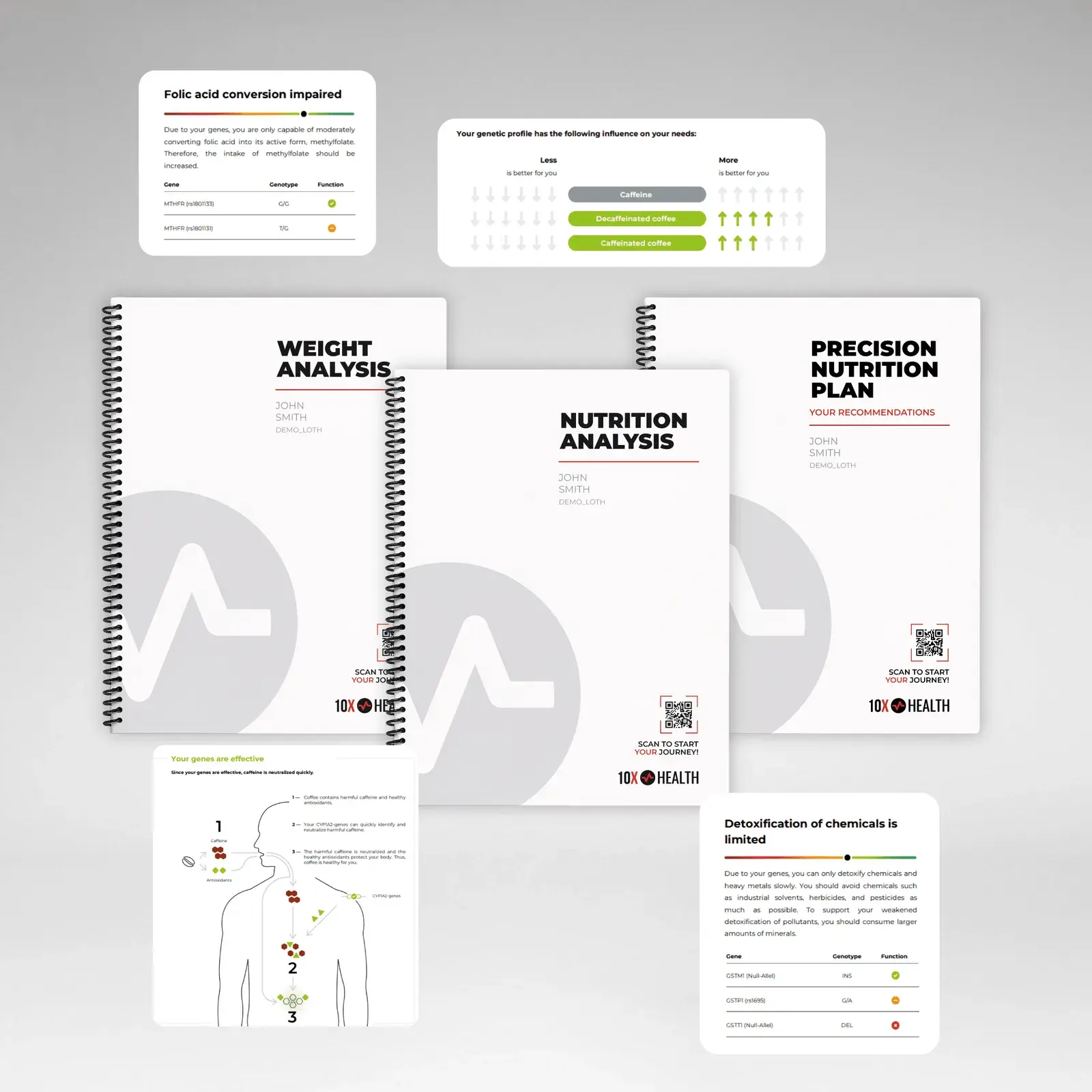 Personalized approachThe 10X Health System Shop now (opens 10X Health in a new tab; affiliate link)
- Save 10%
 Daily foundations10X Health Foundations Shop now (opens 10X Health in a new tab; affiliate link)
Affiliate disclosure: Live10X is an independent educational site. If you purchase through our 10X Health links, we may earn a commission at no extra cost to you. It never changes what we write. Read our affiliate disclosure.
See everything we coverThese statements have not been evaluated by the Food and Drug Administration. These products are not intended to diagnose, treat, cure, or prevent any disease.
Stop guessing. Start with data — and a plan.
Take the free wellness assessment to find your highest-leverage focus areas, then explore genetic testing when you're ready to personalize further.
“Shop 10X Health” is an affiliate link — we may earn a commission at no extra cost to you. Affiliate disclosure